

Origin Story
How it all began...

Sometimes, innovation is born out of necessity. In the energy sector, the need to minimize risk is the top priority. This often stifles any improvements to the infrastructure and, thus, efficiency suffers. The time period was the early 90s and there was a nuclear engineer in Bulgaria. He found himself turning knobs and pulling levers to adjust and stabilize the energy flow. Computer programming in the 90s saw the emergence of languages like C++ and JavaScript to focus on the user experience, adding to the hardware-centric programming of languages like DOS and C.
The engineer envisioned using software to automate manual energy management with predictive modeling and user-friendly interfaces. Subsequently, that engineer came to the U.S. and, while thinking through his solution to better manage energy, was surprised to learn that people were permitted to tie renewables, specifically solar, directly to the power grid. He knew there were concerns associated with feeding real power back onto a grid. It requires a delicate balance of real and reactive power for stability. His dilemma was that grid-tied renewables might lead to further grid instability. If he could create a software-based system to manage grid interconnection, the software would be able to respond quicker to changing conditions. The result: Improved stability and efficiency.

.png)
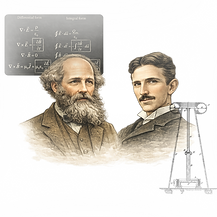
As new ideas arise, so do the challenges of realization. The team realized that shoe-horning the software into existing systems would clearly complicate the process and extend the timeline. They decided to build a full model from scratch, reasoning further that a specific hardware design would be better suited to proprietary software. Generally speaking, "western" thinking is more based on Maxwell's theories focusing on power from electromagnetic field interactions, while "eastern" thinking is based more on Tesla's concepts of energy and energy fields. Given his background thinking about energy rather than power, a unique hardware system was designed based on energy efficiency in order to achieve power balancing.
By combining this grasp of both Maxwell and Tesla’s concepts, the team produced the first microinverter technology that can operate as a virtual spinning generator, managing reactive power with active energy. The result is the Apparent backbone that operates on the principle of injecting energy to balance demand at the source, rather than simply adjusting loads to balance power. The system relies on custom hardware configurations designed to manage energy efficiency with software intelligence balancing the power interconnections in real time.
Today, Apparent continues to refine the software controls that provide predictive adjustments to any source of energy, renewable or otherwise. The same core technology is being applied to solutions for residential, commercial and enterprise customers seeking science backed, data driven and future focused products.
Learn more about what "Apparent" means to us.

Contact
